Yesterday, I opened up the iPod Video I bought last year and made some modifications. There's a big modding scene around these iPods, so parts are easy and cheap to buy online, which is very cool.
Specifically, I did the following things to my iPod:
- I replaced the hold switch and headphone jack assembly, because the old hold switch would sometimes stop working properly and allow the iPod's buttons to be pressed while it was in my bag.
- I replaced the small battery with a much larger 2000 mAh battery, because the battery had been lasting only a couple of hours.
- In order to fit the new, larger battery, I replaced the hard drive with an iFlash Quad adapter board, which accepts microSD cards. I put in two 64 GB Sandisk cards, for a total capacity of 128 GB.
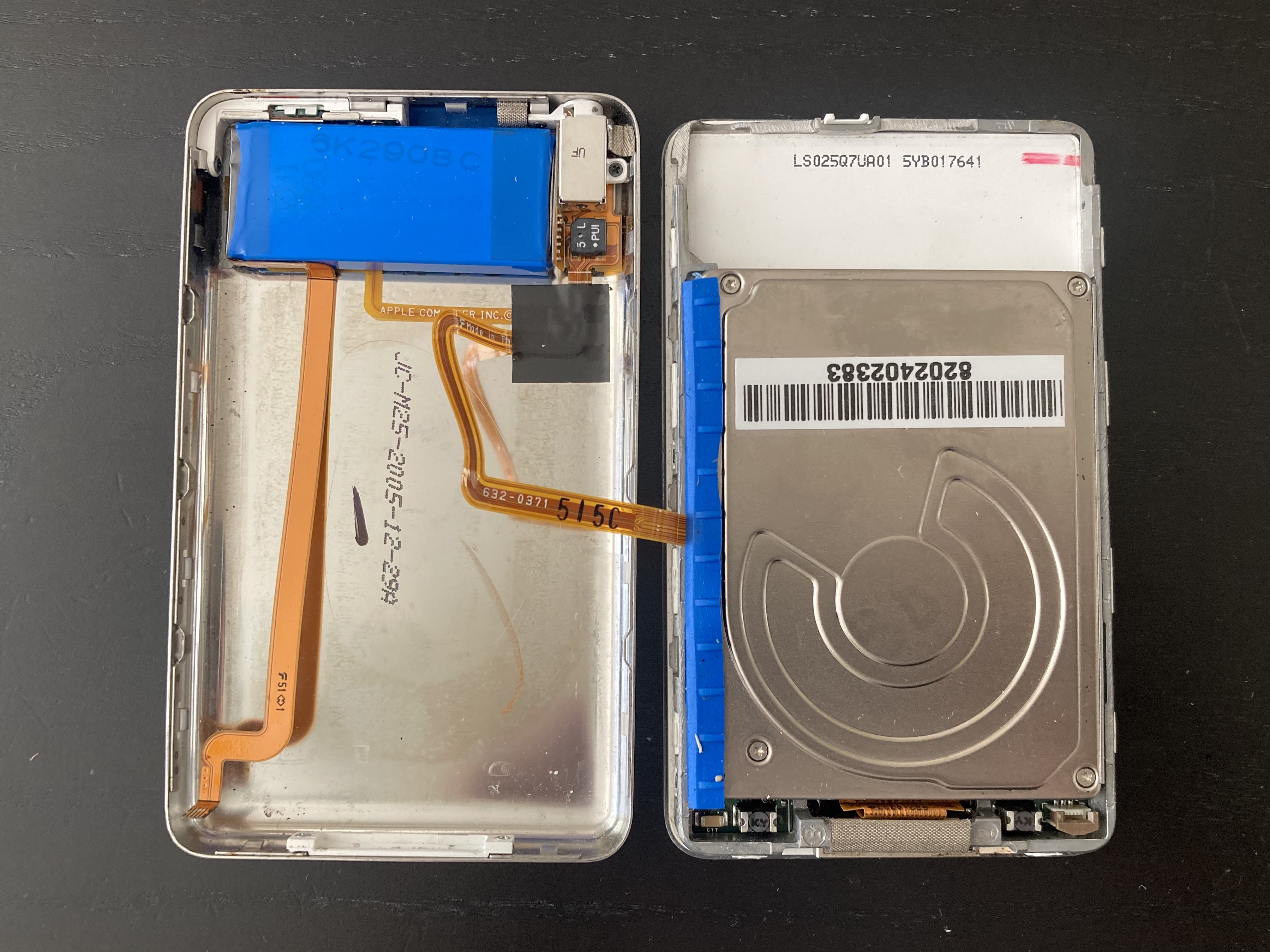
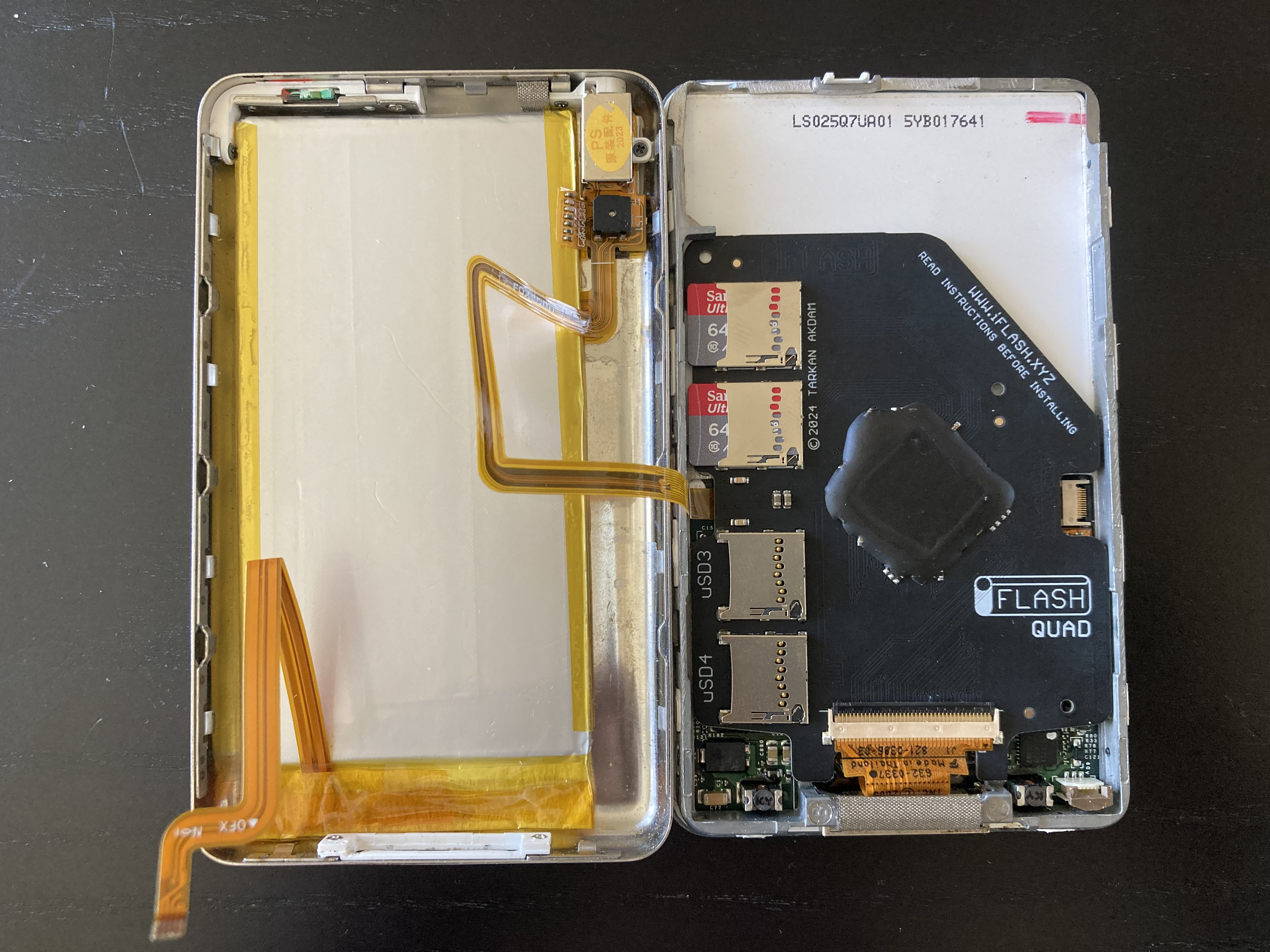
It was all pretty straightforward, and now my iPod has a working hold switch and lots of storage and a huge battery which will probably last weeks! By these metrics, it is way better than it was before. It'll be nice to throw it into my bag and not worry about charging it.
However, I think a bit of character has also been lost as a result.
I recently read the book Why We Drive by Matthew B. Crawford. I'm not sure I'd recommend it to everybody, but there was this one paragraph about old cars which stuck with me:
Old cars elicit a range of feelings. One of them is that elusive feeling that we sometimes try to name with the fraught word "authenticity." The car may bear visible scars of a life fully lived, traces of a past that lend depth to the present. The Road and Track columnist Peter Egan related his reluctance to restore his Lotus that had taken some beatings on the racetrack, and shared the wisdom of a Jaguar enthusiast who told him never to replace anything he could save. "You see these old factory inspector's chalk marks on the back of a dash panel and you realize the whole car is full of English ghosts. If you let them escape … they never come back."
There were many ghosts of 2005 inside my iPod. For example, the hard drive I removed is branded with both Toshiba and Apple's logos, and the little ribbon cable connecting it to the main board is printed with the text "APPLE COMPUTER INC. © 2005". So cool!
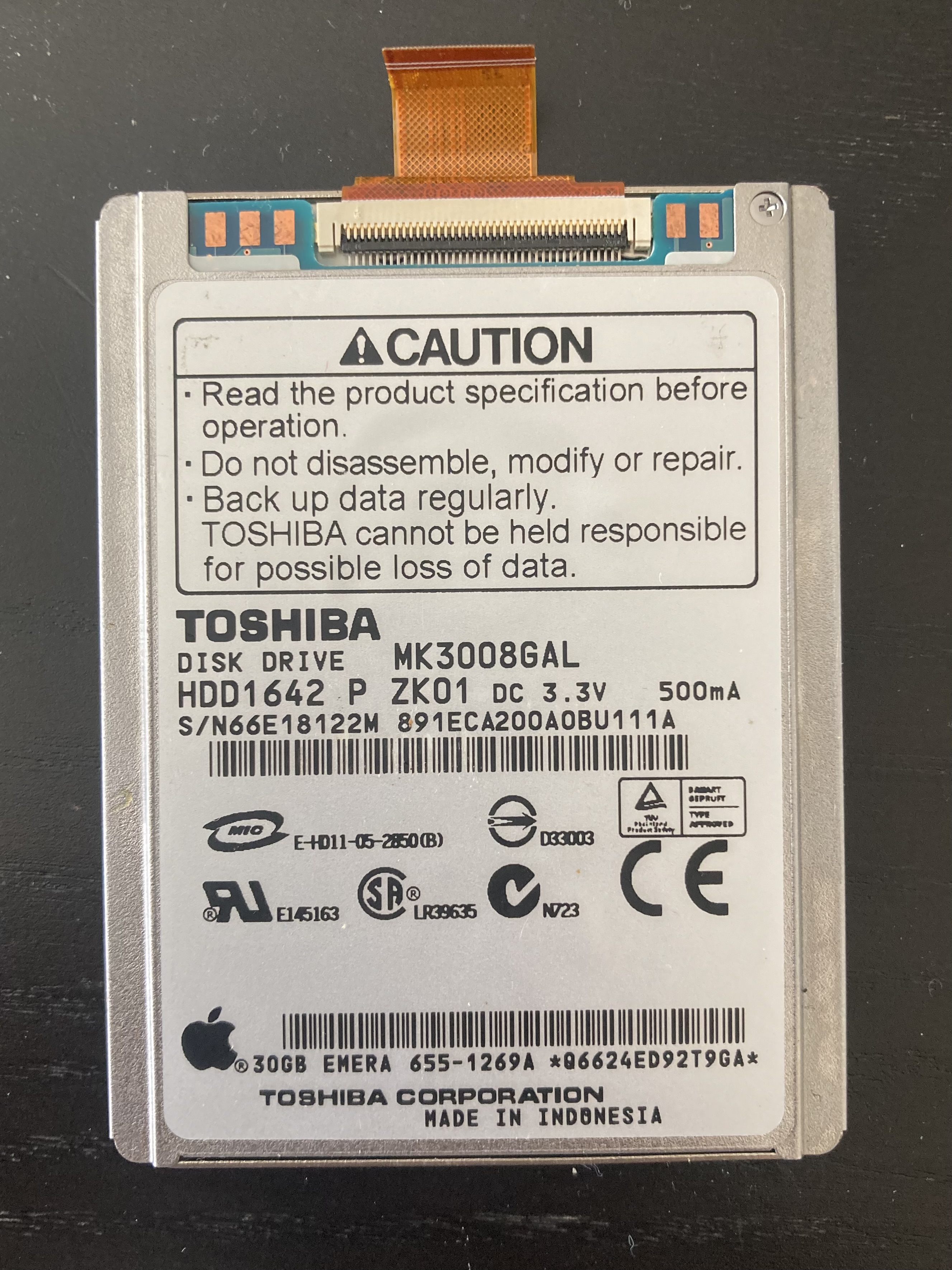
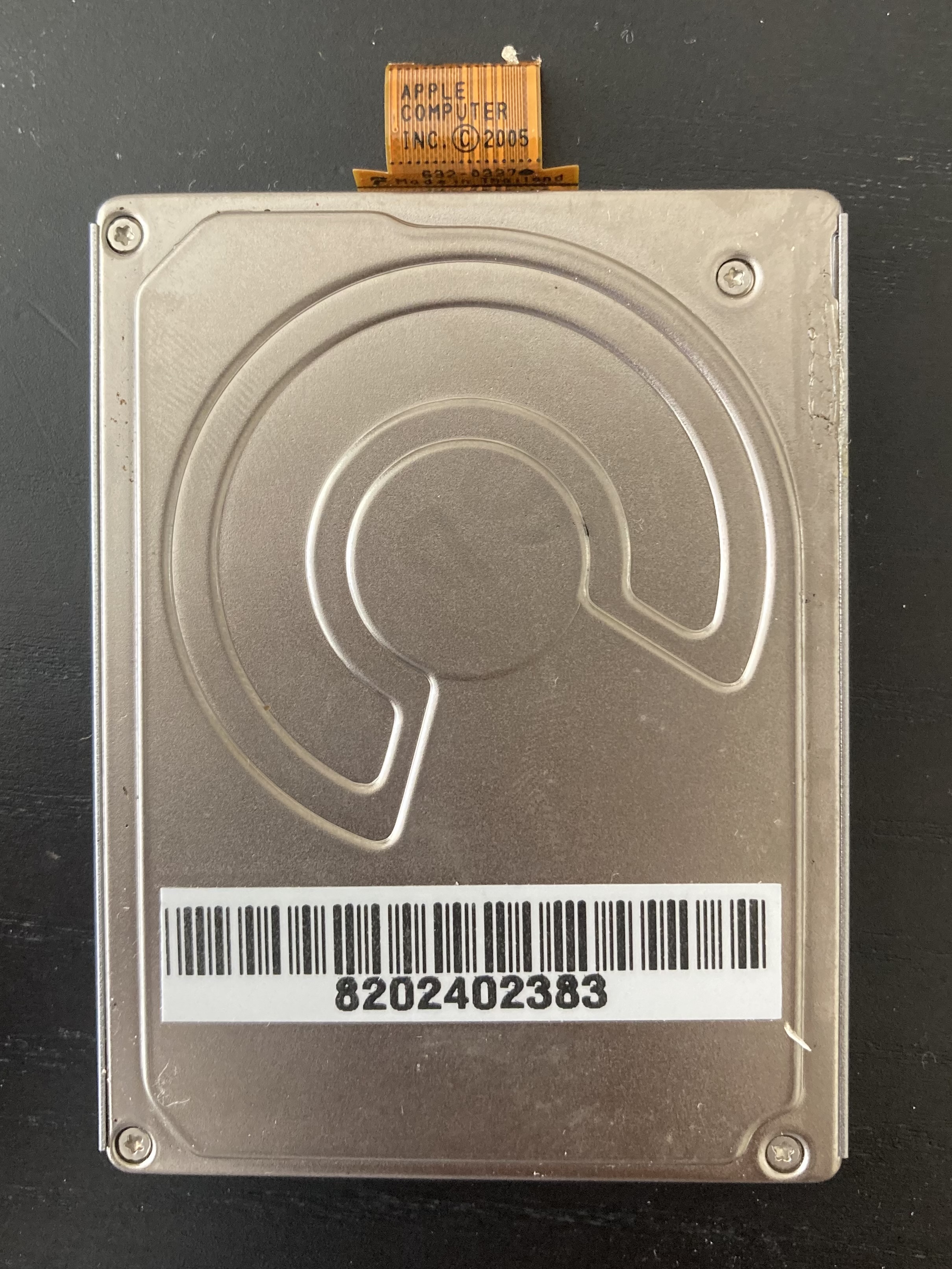
That small spinning hard drive is so core to the character of the iPod. At the time, this was the only memory technology that had enough capacity and was portable enough for this use case. The story of Jon Rubinstein discovering the Toshiba hard drive and purchasing the rights to it is well-documented in Walter Isaacson's biography of Steve Jobs (pages 384-385):
Jobs began pushing for a portable music player in the fall of 2000, but Rubinstein responded that the necessary components were not available yet. He asked Jobs to wait. After a few months Rubinstein was able to score a suitable small LCD screen and rechargable lithium-polymer battery. The tougher challenge was finding a disk drive that was small enough but had ample memory to make a great music player. Then, in February 2001, he took one of his regular trips to Japan to visit Apple's suppliers.
At the end of a routine meeting with Toshiba, the engineers mentioned a new product they had in the lab that would be ready by that June. It was a tiny, 1.8-inch drive (the size of a silver dollar) that would hold five gigabytes of storage (about a thousand songs), and they were not sure what to do with it. When the Toshiba engineers showed it to Rubinstein, he knew immediately what it could be used for. A thousand songs in his pocket! Perfect. But he kept a poker face. Jobs was also in Japan, giving the keynote speed at the Tokyo Macworld conference. They met that night at the Hotel Okura, where Jobs was staying. "I know how to do it now," Rubinstein told him. "All I need is a $10 million check." Jobs immediately authorized it. So Rubinstein started negotiating with Toshiba to have exclusive rights to every one of the disks it could make, and he began to look around for someone who could lead the development team.
When I used my iPod in its original form, I could hear the quiet whirring of the little hard drive inside spinning up and down, and even feel a little bit of vibration in my hand. It felt like it had life. Songs would take a second or two to load from memory, and once in a while driving on a bumpy road, the music would skip.
Now with its new flash memory, songs load almost instantly, while the iPod remains silent and still in my hand. It performs better, but I miss the spirit of the spinning hard drive that used to live inside.
